
Pulaski County Criminal Court Cases
Pulaski County belongs to Illinois's First Judicial Circuit. Its circuit court is the trial court for felonies, misdemeanors, traffic cases, and ordinance matters filed in the county. Illinois circuit courts have general jurisdiction, so readers do not switch between separate felony and misdemeanor trial courts. The case category and number identify the file. A traffic or ordinance entry should not be treated as a criminal conviction merely because an officer issued the citation.
The Pulaski County Circuit Clerk keeps the court file at 500 Illinois Avenue in Mound City. Clerk Stephanie Crain's office provides docket information, ordinary copies, and certified dispositions at 618-748-9300. Fine-only city ordinance matters may start with local enforcement, but no distinct public municipal-court database was documented for Mounds, Mound City, or Karnak. Confirm the filing venue with the issuing agency, then use Judici or the clerk.
Pulaski Criminal Cases in First Circuit
The First Judicial Circuit's Pulaski directory places local proceedings within a six-county circuit. Presiding Circuit Judge William J. Thurston's office is in Room C and can be reached at 618-748-9100. The judge rules on motions, pleas, trials, and sentences. The clerk receives filings and preserves the record. That split matters: clerk staff can locate documents, but cannot give legal advice, reschedule a date, or change an order.
The official First Circuit source is represented in the capture below.
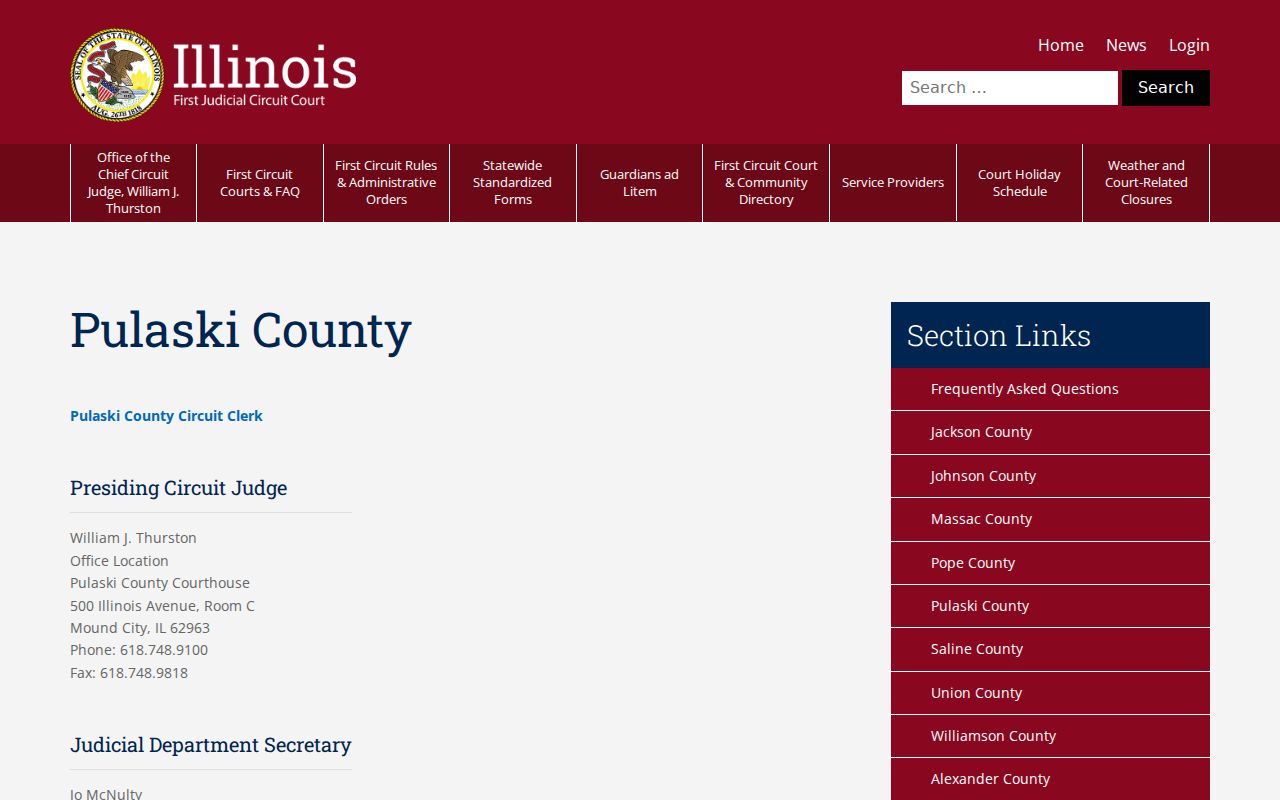
Confirming the court first reduces the risk of relying on a similar name from a different Illinois county.
Searching Pulaski County Case Records
Judici is the participating-county public docket used for Pulaski County criminal court cases. Illinois has no single, complete anonymous trial-court search for every circuit. Start by selecting Pulaski County. Use a case number when known and otherwise search the party name with care. Similar names can produce false matches, so compare the filing year, case category, and docket facts before attributing a result.
- Open Judici and choose Pulaski County before running a search.
- Enter the exact case number, or search the party's legal name and spelling variants.
- Separate criminal entries from traffic or ordinance matters and compare filing years.
- Read counts, event dates, status, and disposition as distinct fields.
- Call the Circuit Clerk for pleadings, orders, certified dispositions, or missing items.
| Field Label | Type | Required | Notes |
|---|---|---|---|
| County | Select | Yes | Choose Pulaski County. |
| Last name | Text | Name option | Use legal spelling and variants. |
| First name | Text | No | Narrows common surnames. |
| Case number | Text | Alternative | Most direct route to one docket. |
| Case type or year | Filter | No | Separates record categories and filing years. |
Judici Is Not Pulaski's Whole File
The public docket is an event index, not a scan of every document. Judici may show that a complaint, motion, order, or judgment was entered without making the image available. Financial entries may appear, but online payment does not excuse a required court appearance. A future hearing is not an outcome. Likewise, the first charge listed is not always the count that finally resolves the Pulaski County case.
The official Judici interface appears in the captured source below.
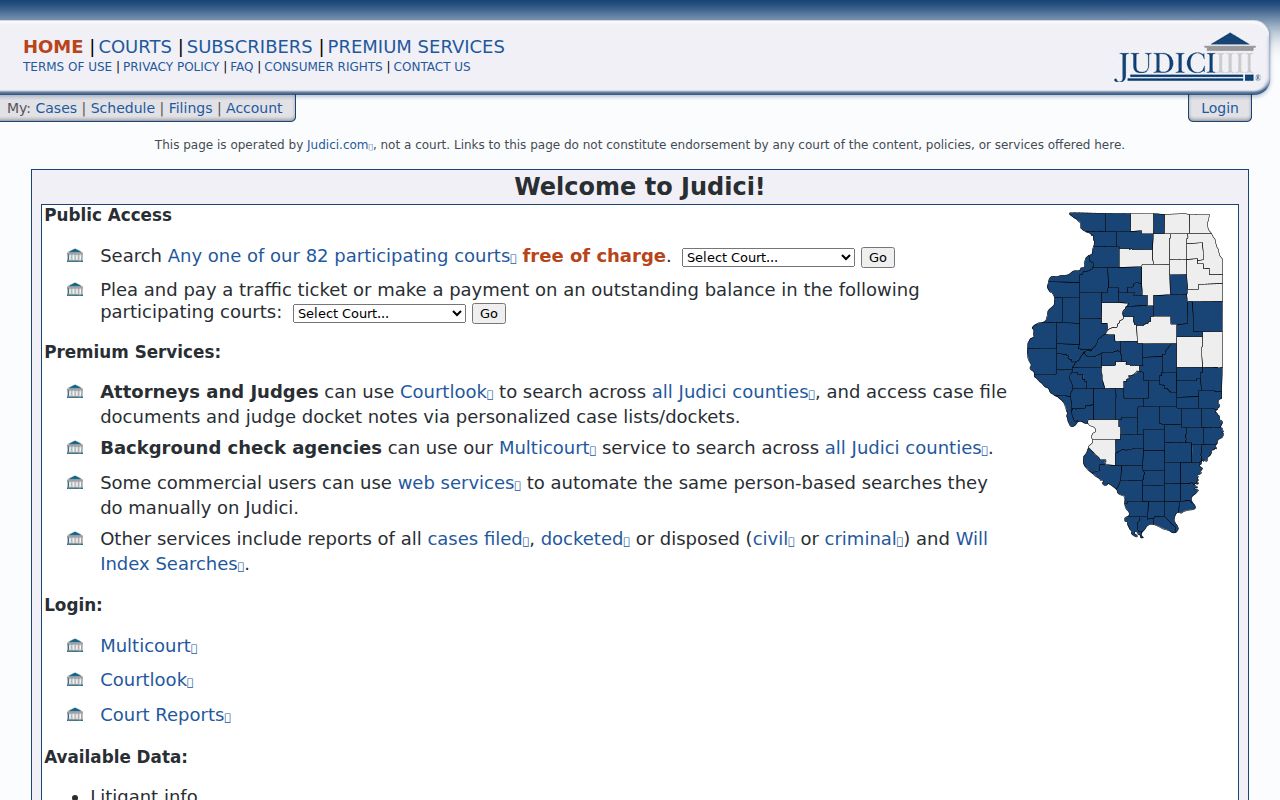
Use the docket to identify the file, then request the underlying order when its exact terms matter.
Inside a Pulaski County Case File
A Pulaski County criminal case file centers on the court number, counts, parties, docket events, and rulings. It differs from a jail booking file, which centers on custody, and from an Illinois State Police response, which organizes fingerprint-linked cycles. For the outcome, the disposition and judgment matter more than the arrest entry. For the exact sentence, obtain the sentencing order or certified disposition instead of relying only on a short docket label.
| Case Number & Court | Identifies Pulaski County, category, filing year, and unique file. |
|---|---|
| Charging Document | States filed allegations; later amendments may change individual counts. |
| Docket Entries | Lists filings, appearances, pleas, motions, orders, warrants, and judgment events. |
| Hearing Dates | Shows past and future settings, often with hearing type and courtroom. |
| Disposition & Judgment | Shows dismissal, acquittal, supervision, plea, verdict, or another final result by count. |
| Sentence & Conditions | Records custody, probation, restitution, and other ordered terms where applicable. |
Get a Pulaski Certified Disposition
A certified disposition is the practical record when a short online status is not enough. Give the Pulaski County Circuit Clerk the exact case number, party name, and approximate year. Ask whether the record can be emailed or mailed, whether inspection must occur at the counter, and what copy or certification cost applies. No reliable current Pulaski County fee schedule was published, so request a quote rather than assuming a price.
The Circuit Clerk's official page supplies the source shown below.
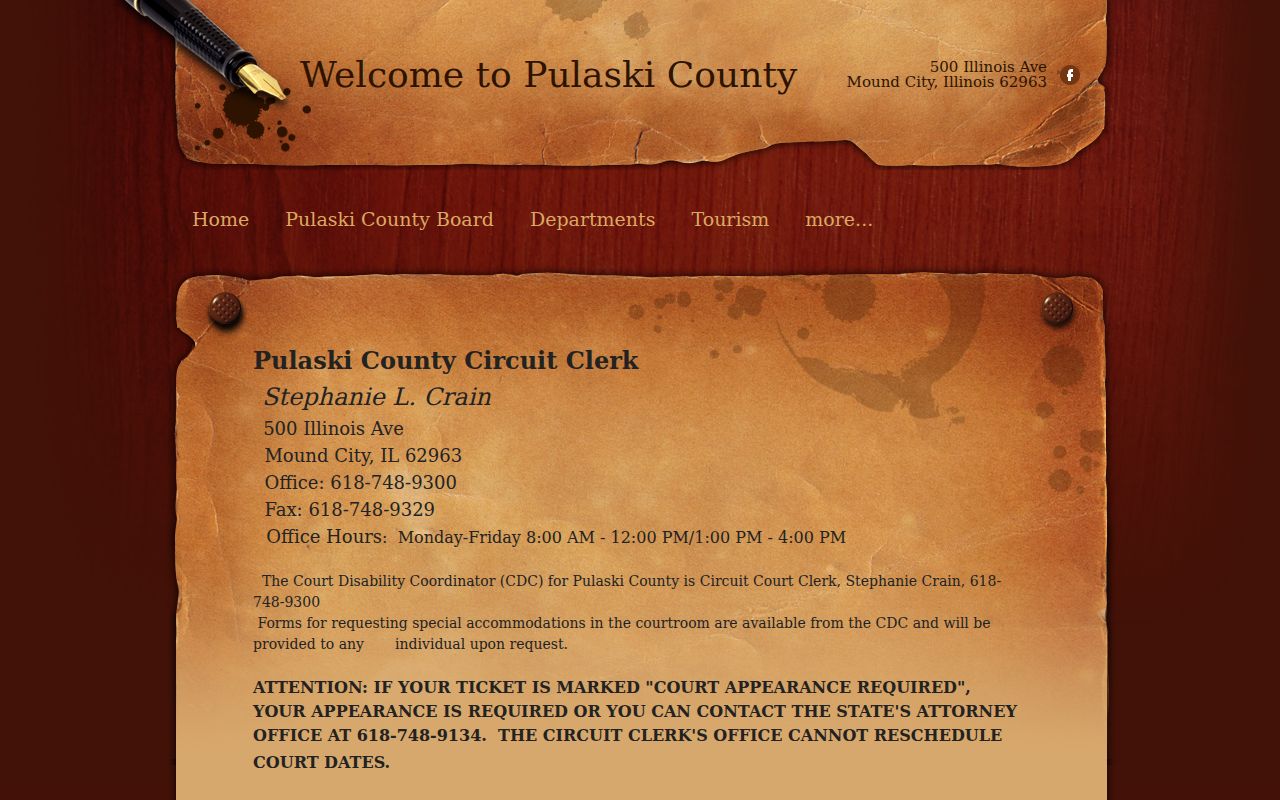
A certified clerk record can also support correction of a missing or wrong disposition in a state criminal history.
How a Pulaski Criminal Case Moves
A case may begin with arrest or summons, but the prosecutor decides what charge to file. The first court events address appearance, counsel, and pretrial release or detention. Arraignment is the hearing where charges are formally addressed and a plea is taken. Discovery and motions follow. A Pulaski County criminal case can end through dismissal, negotiated plea, acquittal, or guilty verdict, with sentencing after a conviction.
Case flow: Charges Filed › Arraignment › Pretrial › Plea or Trial › Disposition › Sentencing
Illinois's current pretrial framework uses release conditions or a judge's detention order rather than treating a cash-bail schedule as the default for new cases. Older docket entries may still say “bond.” Read the event date and signed order before interpreting that term. Appeals, when filed, add another stage without erasing the Pulaski trial-court record.
Read Pulaski Case Disposition Terms
Short labels can hide major differences. Read the result for each count, since one charge may be dismissed while another ends in supervision or conviction. “Nolle prosequi” means the prosecutor formally declined to continue that charge. It is not guilt. Supervision can avoid a judgment of conviction after successful completion, while a plea or verdict followed by judgment is a conviction.
- Disposition
- The final outcome entered for a charge or case.
- Arraignment
- The hearing where filed charges are addressed and a plea is taken.
- Nolle prosequi
- The prosecutor's formal decision not to proceed further on a charge.
- Supervision
- An Illinois result that may avoid conviction after successful completion.
- Bench warrant
- A court order authorizing custody, often after failure to appear.
Older Pulaski Criminal Court Records
Judici should not be treated as the full historical boundary of Pulaski County criminal court cases. An older file may exist at the clerk's office even when the name search returns nothing. Give the clerk a legal name, an approximate filing year, and the best available charge description. A former name or alternate spelling can be important. If a case number appears in another document, use it because it is more precise than a name alone.
Some truly historical court material may have moved to the Illinois Regional Archives Depository system. Ask the Circuit Clerk whether the requested Pulaski County record remains locally held or was transferred before contacting an archive. The archive path is best suited to genealogy and historical research, not to guessing at a recent case that simply has not reached the online docket. Certified modern outcomes should still come from the clerk that maintains the case.
Note: An empty online search does not prove that no Pulaski County court file exists.
Pulaski Case Record Access & Restrictions
Ordinary Pulaski County court records come from the clerk under court access rules, not through an Illinois FOIA request against the judiciary. Sealing orders and identity-protection standards can limit online and counter access. Juvenile matters, sealed or expunged cases, protected identifiers, and sensitive victim information do not appear in ordinary public view. A missing Judici result can reflect spelling, an offline record, or a lawful restriction.
When a case cannot be found, contact the clerk with the name, approximate year, and charge. Older Pulaski files may have moved to the Illinois Regional Archives Depository. Ask about that path before assuming a file is gone. For executive-agency records, such as a sheriff report, the Illinois Freedom of Information Act is the right route. Court case access remains separate.
Public access also does not mean every identifier is open. Clerks and courts protect Social Security numbers, some addresses, juvenile information, and other data covered by court rules. Sealing restricts ordinary public access while the record remains available to those authorized by law. Expungement can remove qualifying records under Illinois law. If a Pulaski County case once appeared but later vanished, ask the clerk whether access is restricted instead of treating the old screen result as current. The signed sealing or expungement order controls, not a cached docket or an old printout.
The Illinois Courts directory supplies the courthouse source below.
Confirm each Pulaski County criminal case with the office that maintains its signed orders.