
Checking Criminal History in Karnak
Karnak has no verified official police-record portal, arrest blotter, app, or separate municipal docket. The first task is not typing a name into a city database. It is finding the agency that made the stop, wrote the report, or took the person into custody. A citation, report number, dispatch reference, or officer identity can resolve that question.
Use a five-part path:
- Ask Karnak village government which agency served the exact location and date.
- Request the incident or media from the village, Sheriff, or ISP, whichever created it.
- Ask the county detention operation about a booking, since no official live roster was located.
- Confirm the court on the citation, then search Pulaski County through Judici or call the Circuit Clerk.
- Use ISP's official process for Illinois conviction information or personal record review.
Identify the Karnak Responding Agency
Law-enforcement arrangements in a small village can change. Do not assume that every Karnak event belongs to a village police file. A Pulaski County deputy or Illinois State Police trooper may be the creator and custodian. The exact street or rural address, event date, approximate time, vehicle description, responder, and report number help village staff route an inquiry.
If the village confirms that its officer created the record, request it there. If the Sheriff answered, use the county records or FOIA channel. For an ISP response, contact ISP through its official public-record process. Asking all three bodies for the same broad name search wastes time and can return unrelated records. A narrow event-based request is more accurate and exposes less private data.
Karnak Police Department Records
The research did not verify a stable online Karnak police records unit or request form. Begin with village government and ask for the current FOIA officer, law-enforcement custodian, address, hours, and submission method. Confirm those facts before sharing a date of birth or attaching identity documents.
State the exact record type: incident report, arrest report, citation, crash record, dispatch audio, or video. Include the Karnak location because overlapping responders matter. Give the incident date and time, report or vehicle number if known, preferred electronic or paper format, and contact information. Ask for a fee estimate and for the written statutory basis of any denial or redaction. A village can only produce records it possesses or controls.
Karnak Village or Sheriff Record
A village report and a Sheriff's record may describe different stages of one event. The first responder can create the incident narrative while a deputy later transports or assists. Jail staff then create a separate booking record. Keep agency names attached to every document during a personal review.
This is also why a missing Karnak village response does not prove the event did not happen. The request may have gone to the wrong custodian. Check the citation header, arresting-agency field on a booking record, and agency name on the court docket. Then send a focused follow-up. For a case outcome, move to the Circuit Clerk rather than asking law enforcement to interpret the judgment.
Karnak Arrests and Bookings
A Karnak arrest generally routes to the Pulaski County Detention Center unless the arresting agency identifies another receiving facility. County jail intake produces the custody record. It can include booking time and number, arresting agency, identity descriptors, initial charges, and release or detention status. No official online roster was verified.
Call the detention operation for current public custody facts or use the jail's written FOIA instructions for retained booking records. Do not use IDOC's state-prison search as a substitute for a county pretrial inquiry. IDOC applies after a qualifying commitment to state custody and can also show some supervision information. The Pulaski arrest lookup page gives the county-wide fallback options while Karnak remains focused on finding the right local responder.
Karnak Criminal Data at Small Scale
The research uses a 2020 Census count of 430 for Karnak, ranking it third among the county's incorporated places. In a village of that size, one event can sharply change a rate. Published counts should be paired with the covered year, reporting agency, offense definition, and population base.
A high percentage does not identify a person or prove a present danger. It may reflect a small denominator or changes in agency reporting. Use statistics for broad context, not as a replacement for a court file or incident record. When later annual estimates are used, label them as estimates and do not silently compare them with a decennial Census count.
Municipal Court Records in Karnak
No separate Karnak municipal case portal was verified. Read the court line printed on the citation. Matters filed in Pulaski Circuit Court can be searched in Judici, and the clerk can answer questions about public docket access and certified copies. The filed court case, not the initial village or police allegation, records the adjudication.
| Court Name | Circuit Court of the First Judicial Circuit, Pulaski County, when filed there |
|---|---|
| Case Types Heard | Felony, misdemeanor, traffic, and ordinance matters within circuit jurisdiction |
| Case Lookup Channel | Judici or the Pulaski Circuit Clerk at Mound City |
| What the Docket Shows | Case number, counts, filings, scheduled events, status, orders, disposition, and sentence when public |
| Copies & Fees | Ask the Circuit Clerk for current copy and certification costs |
If the citation names another court, follow that printed instruction instead of forcing the search into Pulaski.
Karnak Citations Identify the Court
The court name and appearance language on a citation are practical routing tools. They can show whether the matter is set in Pulaski Circuit Court and whether attendance is required. A person search in Judici should still be verified with case number, filing year, charge, and docket events.
Online docket text may lag or omit images. A blank result can mean the case is new, indexed differently, protected, never filed, or assigned elsewhere. Call the clerk rather than guessing. If a certified result is needed to correct your own repository history, request a certified disposition and keep the receipt and case number for ISP's challenge process.
Where Karnak Records Go
When a Karnak incident leads to arrest and prosecution, information moves through several systems. The responding agency retains its report. The county detention center creates booking data. The State's Attorney chooses charges, and the Circuit Clerk opens the case. Fingerprint arrest data and qualifying dispositions can be sent to ISP's Bureau of Identification.
Record flow: Karnak responding agency › Pulaski County Courts › Illinois State Police Bureau of Identification
Timing gaps are normal. A police report can exist without a booking. An arrest can end without a filed case. Judici can show a court result before ISP has matched the disposition. Public UCIA information is conviction-only. A complete self-review compares the precise record held at each stage.
Karnak Cases and Pretrial Services
Pulaski County participates in Illinois statewide pretrial services. Current docket terms may refer to release conditions, assessment, or a detention hearing under the state's pretrial framework. Those entries describe a stage of the case, not a conviction.
The Office of Statewide Pretrial Services publishes the Pulaski courthouse service listing.
The official listing connects Karnak cases filed in the county court with the proper local service location.
Use the signed court order and clerk docket for the judge's action. Pretrial supervision files are not interchangeable with the public case file.
Karnak Conviction Information Routes
ISP's CHIRP and paper UCIA process provide authorized access to reported Illinois conviction information. A public name response can confuse similar people, while fingerprint review provides a stronger identity match for one's own history. CHIRP requires authenticated access, and current fees should be checked before ordering.
The Uniform Conviction Information Act defines the Illinois public conviction framework.
The statute also shows why a public statewide response is narrower than every arrest and police report tied to Karnak.
Use a licensed live-scan vendor when the official process calls for fingerprints. No fixed vendor inside Pulaski County was confirmed, so verify service before travel.
Federal Records Connected to Karnak
A case filed in federal court will not appear as a Pulaski Circuit Court case. PACER is the federal docket route, and the Bureau of Prisons locator covers federal custody. The U.S. District Court for the Southern District of Illinois is the relevant federal court source for this region.
The Southern District of Illinois publishes official court information.
This federal layer should remain separate from a Karnak village report and Pulaski County docket search.
A federal charge, state conviction, and local booking are not three versions of one database. Search the jurisdiction that actually handled the matter.
Karnak Court Help and Public Defense
The public court file can identify counsel and events, but it cannot provide legal advice. A person who faces a current charge should use the court's official process for counsel eligibility and deadlines. Do not treat a records request as a motion or as a way to change a hearing date.
The Illinois public defender directory identifies official county contacts.
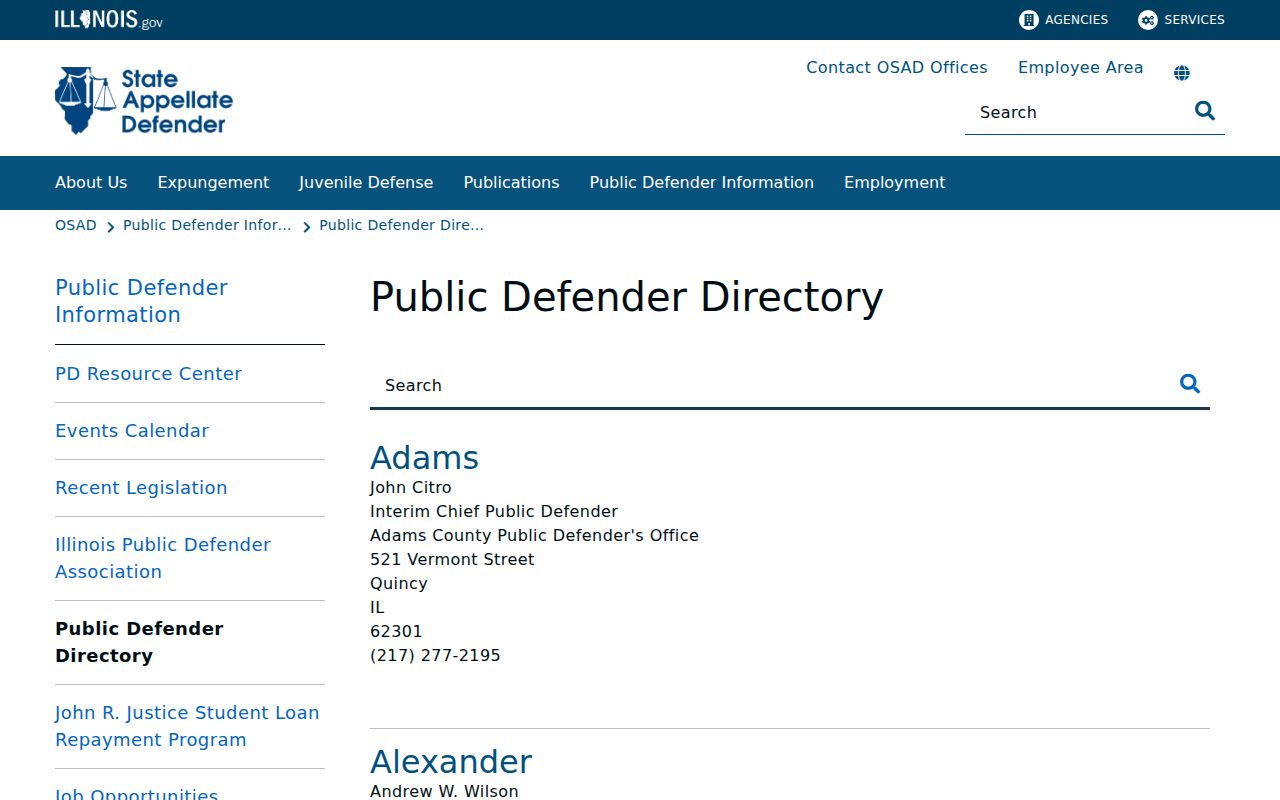
The directory helps route a Karnak court user to an authorized defense office instead of an unofficial listing.
For pure record access, keep working with the custodian: agency for reports, jail for booking, and clerk for the court file.
Karnak Registration Records Are Separate
The Illinois State Police Sex Offender Registry is offense-specific and is not a complete Karnak criminal history. Registration can include address, offense, agency, duration, and compliance information required by statute. The underlying conviction remains a court record.
The Illinois registration procedure statute describes reporting duties and the statutory fee.
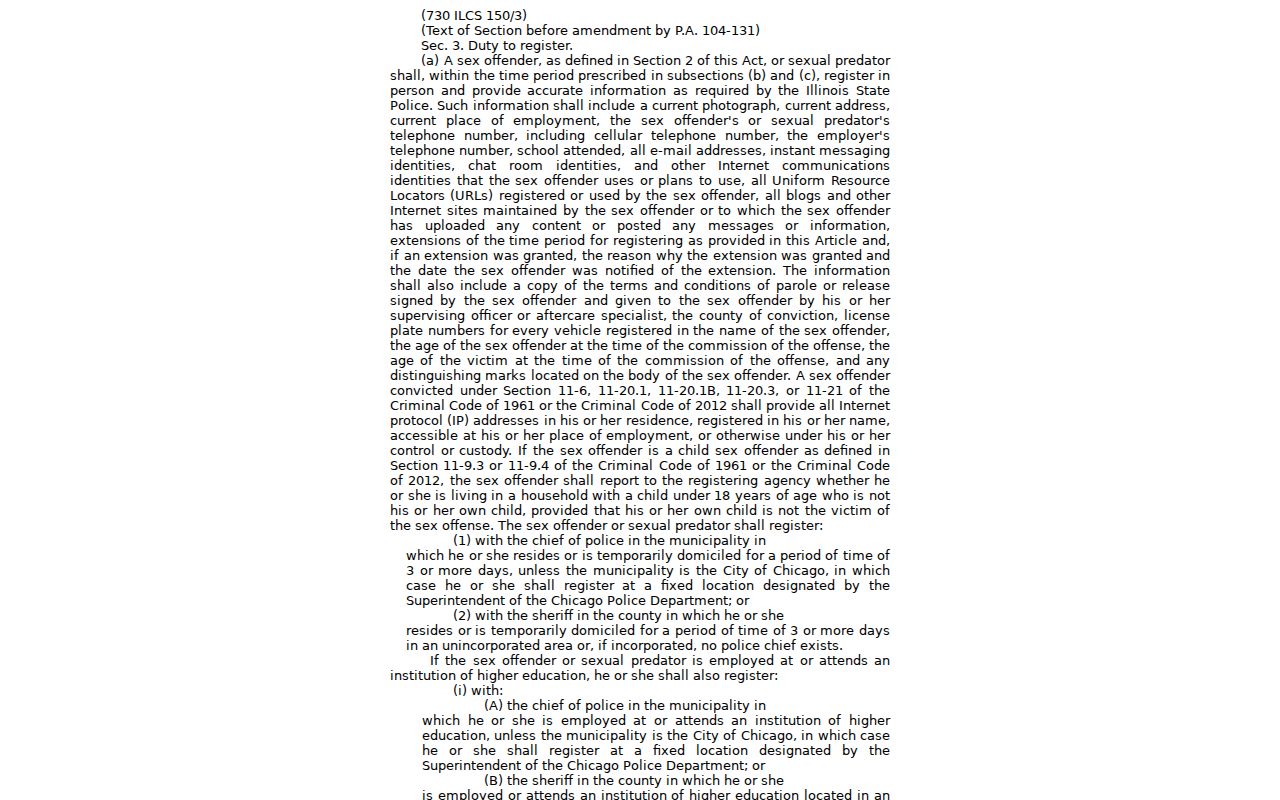
That law explains the registration process without turning registry status into a general risk score.
The registration-duration statute addresses ten-year, lifetime, and extension rules.
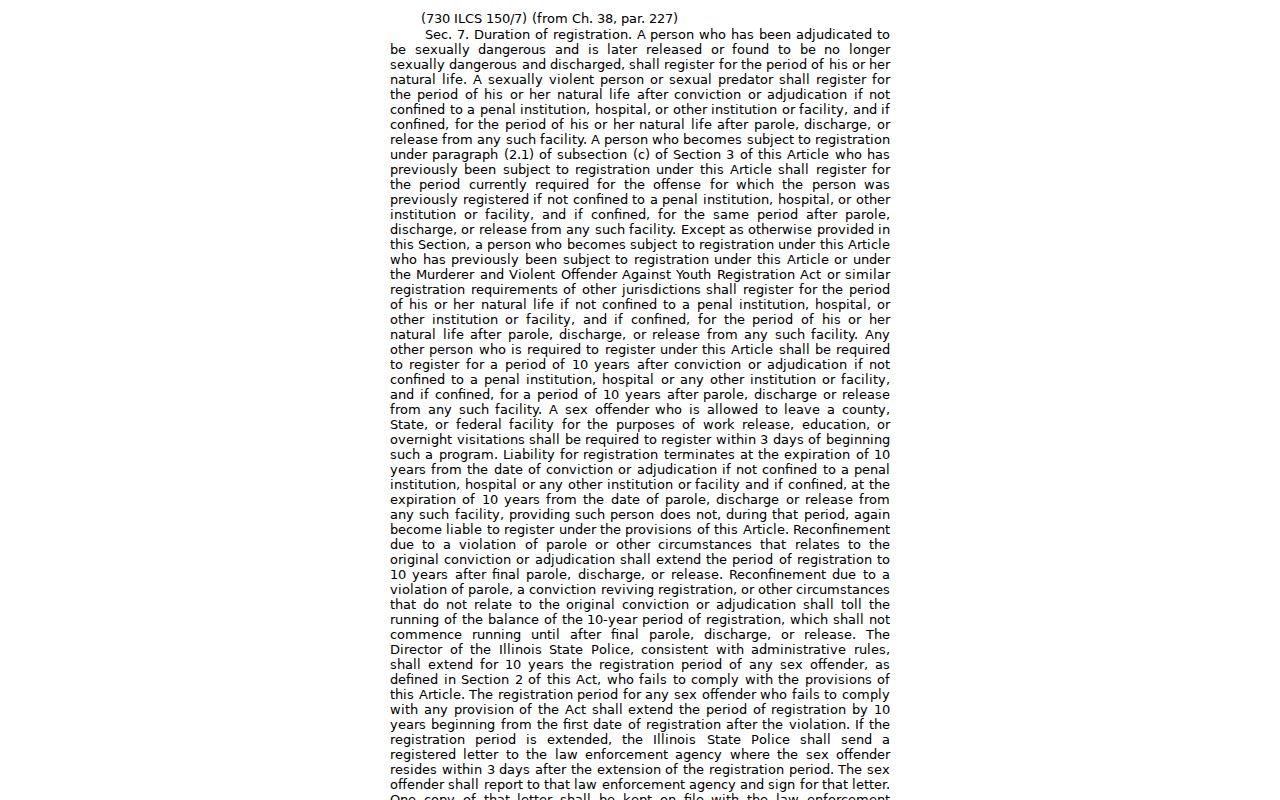
Duration depends on the statutory category and compliance history, not simply the village where a person is listed.
Public Access Rules in Karnak
Illinois FOIA governs requests to village and county agencies, while court access is controlled by court rules, statutes, and orders. A record may be redacted to protect private facts or withheld under a cited exemption. Active-investigation concerns, juvenile status, sealing, and expungement can limit public release.
Ask for a written basis when access is denied. A narrower request can often separate releasable portions from protected material. ISP public conviction data should not be described as a full arrest record.
Key Statutes:
Illinois Freedom of Information Act, 5 ILCS 140 governs access to records held by the village, Sheriff, and other public bodies.
Criminal Identification Act, 20 ILCS 2630 covers criminal-history handling, correction, expungement, and sealing.
Uniform Conviction Information Act, 20 ILCS 2635 establishes public access to Illinois conviction information through ISP.